Now blogging at THIS SIMPLE HOME.

Now blogging at THIS SIMPLE HOME.

At This Simple Home

Showing posts with label preschool resources. Show all posts

Tuesday, January 17, 2012

The Benefits of Preschool

After sharing last week that I think preschool is optional, I realized that some reading may not understand our reasoning for sending our children to preschool...especially since I did not tell you the benefits of preschool.

As a former teacher with the internet available to me with all of you preschool and homeschool blogs out there, I think I could do just fine preparing my children for kindergarten academically.  So can most moms who want to.  Yes, I could keep M at home, but I don't.

Here are a few reasons for a family to choose preschool off the top of my head.

At preschool the child will benefit from being taught by someone other than the parent.  Some children really respond well to other adults for instruction and discipline.

The child will grow socially.  Some children are extremely shy, while others have a need to be around others.  Preschool also addresses social skills such as taking turns and sharing without the sibling rivalry.

The child may have opportunities to learn something new and develop new interests.  Ideally, the children in a preschool will have many opportunities for physical movement, music, and art in addition to regular academics.  Often there are also opportunities for children to perform in a play or to sing songs to an audience.

The teacher is always "on."  The teacher has no other duties (like laundry, dishes, or supper) while they are with your child.  (Like any working parent, it waits until they are home.)  The learning day is quite focused.

Preschool is an introduction, not mastery of academics.  I think it is great for children's first school experience to be FUN.  Academic pressures should not arise in preschool because it is an introduction, though parents and teachers should still encourage a child to do their best.

Now that I have written just a few thoughts, I can easily think of ways to meet each need at home, and you probably can, too, as long as a parent does not work.  I admire my homeschooling friends...and often wonder how in the world they do it.  But, like most things, it is a learning process for all involved.

We've completed lots of preschool activities (linked to posts) at home, despite preschool.  (Here is a list of preschool activities.)

What do you do for school (now or in the future)?  Homeschool, public school, or private school?  
Why do you do what you do? 

Tuesday, January 10, 2012

What Should My Preschooler Know?

Do you ever wonder what your child should know at his or her age?  Whether you homeschool or send your child to school, there are certain expectations for children, but you might be surprised at how little a preschooler actually needs to know.

I have always said that preschool is optional.  And that is true-for most* children.  Many children's educational, social, spiritual, and emotional needs are met naturally through family and friend interaction.  (FYI, we do send our oldest child to preschool and her brother will likely go next year.)

My oldest child has always loved to learn.  Because she loved it, I taught her through daily life and purposeful play.  When she was ready and excited, I took it to the next level with crafts and even worksheets.  She ended up being an early reader.  My son does not love crafts (unless dirt or paint is involved).  He does not like me to guide his play in any sort of way.  He certainly won't be ready for worksheets any time soon.  And you know what?  He knows plenty of "academic" type stuff as a three year old!  He has learned much through our daily lives.  It's easy to collect and count rocks and identify letters on a cereal box.  And despite the fact that he does not hold scissors or writing tools properly...it is not a concern.

I really enjoyed the Peaceful Parent's perspective....really a four year old child just needs to know they are loved!  Children need their parents more than anything else!

World Book (you remember those encyclopedias that no one uses now thanks to the internet) put together a list of "Typical Course of Study" for preschool through grade 12.  I really enjoyed looking at the preschool course study.  They don't suggest that a four year old know all the letters and the sound correlations.  BUT they do want a child to have his own books and to be read to frequently and to be read to daily.

I really think a list like this is near-perfect for parents.  (Teachers need to meet national and state standards in education, so that is a bit different.  Also keep in mind that speech and motor development are not really addressed here.)  It helps us to know that we're doing the right things at home.  At the same time it can show us areas of weakness.  For example, I want to encourage my daughter a bit more to take the lead when crossing the street when the opportunity arises to see what SHE does even though we talk about it.  By taking a quick look at the list parents can see if there is anything obviously missing in their own children.
Jumping barefoot in the rain puddles is what they'll remember...and so will I.  I think embracing the moment and showing love is exactly what I need to do for my children-in between read alouds!

* In MY opinion, if a parent cares about what their child knows before kindergarten, they are likely doing enough.  After talking to a friend who is a kindergarten teacher, it sounds like ESL children, whose families do not speak English in the home, would benefit from preschool before kindergarten.  There are plenty of other situations when children benefit from preschool for more than the "social" reason.

Tuesday, April 5, 2011

Fabulous Beginning Reader Resources


First, I just have to say that my daughter is just beginning to read.  She reads three letter words and some longer words that are important to her or with an "s" ending.  We've been using the BOB books, and we really like them, as I talked about here and here.

I love the blogging world and am constantly amazed at the talents of parents who easily create things to help teach their children.  I just like to use what they make!  So today I'm sharing a bit of what

Go Fish or Memory PHONICS~ Match the picture to the word!  Ticia at Adventures in Mommydom created this game.  I was really excited when I saw that I could save the document to a Word document and put in our own Dad picture.  I printed this on carstock for durability.  However, you could print on regular paper and then glue to construction paper to create your own cards.  For my 4 year old, we divide the cards into two groups before playing, so it is like we have two sets of playing cards.  (Pictured are just a few cards.)

K4 Curriculum~ Erica at Confessions of a Homeschooler has TONS of stuff for you to print.  Honestly, she could work for a publisher of early childhood workbooks.  We will begin with this Beginning Sounds pages.  We have a couple of workbooks that I definitely need to be using more often!  I like that Erica has a mix of writing practice combined with the reading and sometimes it is just reading by having the child draw a circle or a line.  (Pictured here is just one of the pages we did.  It earned an extra smile because her name was written so it could be read!!  The teacher in me awards stars.  If you do the same, I would suggest letting young children make corrections so that you can always award the star.)

This next one is not from a blog, but from Nick Jr.  Yes, we watch Nick, Jr.  Several months back I went there to explore what learning things they might have.  Almost all of their games and printables are related to a character from a show.  However, I did find several word family activities.  They were to be cut out and matched.  I took it a step further.  I cut, laminated, and created a file folder game.  Honestly, it is a touch easy for M at this point, but it still reinforces what she is learning!

Word Families -UG, -AN, -AT.  These are puzzle-style where the child matches the correct letter to the word ending to create the word for the picture.  They are color coded, so they are self-checking.  (Or just match them without too much thought, though I still like them.)  Use them as puzzle pieces or create a folder game like I did.  (M was actually completing the puzzle upside down.  She was just matching colors, though she could "read" the words-or at least look at the pictures.)

Wednesday, February 2, 2011

A Book about Cancer...and More

We love to read in our home, but I've recently noticed that almost all of our books are fiction or Bible stories.  A while back, I bought some nonfiction books, and I'm pleased to share them with the children.  I am also excited to have the opportunity to review some books from Sylvan Dell Publishing, who teach science and math through literature to children.  You can see my other Sylvan Dell reviews here and here.

Champ's Story: Dogs Get Cancer Too!A book that will be a valuable resource for parents, children, and teachers when they or a loved one (including pets) is facing cancer is Champ's Story: Dogs Get Cancer Too! Cody discovers a lump on his dog, Champ.  Unfortunately, it is cancer.  Champ undergoes many of the same treatments that people undergo.  He even experiences some of the same side effects.  This is a tender, yet informative story for children.  Though this is a heavy topic, author Sherry North tackles Champs's Story with a positive attitude.  The section titled "For Creative Minds" included in the back of the book would be extremely beneficial, along with all the Teaching Activities at Sylvan Dell.  I once had a student whose brother was fighting cancer.  I would have loved to have shared this with Sarah and her classmates, but especially her family and brother's teacher.  I highly recommend this book to help a child understand cancer.  Champ's Story even deals with the guilt a loved one might feel as they wonder if they could have prevented the cancer.  It is important to note that Champ overcomes his cancer.  (I will also share that I have not read this book to my children.  I feel that it's still a bit early to introduce cancer through a book since we do not have a loved one facing cancer.)

Fur and FeathersFur and Feathers caught my daughter's eye immediately.  Not only that, but she enjoyed learning about animals and Sophia is awakened by a howling wind.  She eventually returns to sleep after her mom's suggestion to count animals.

In her dream the wind removes the animals' coats.  The animals are cold in their bare skin, so Sophia goes to her closet to give them lots of clothes.  The animals are thankful for her help, but soon Sophia realizes that clothing doesn't really work for the animals.  She goes to her mother's sewing box to make new coats for the animals.  Each animal tells her about their special coat.  I really like how author Janet Halfmann relates why each animal's coat is special to it.  For example, the frog doesn't wear a coat over its skin, but it does have a covering of slime to keep it moist.  The fish and snake both have scales, but the snake needs dry ones.  I appreciate a story that not only has adorable illustrations (by Laurie Allen Klein), but a story that draws my daughter in and educates her, too.  Not surprisingly, this book recently won gold in the Moonbeam Children's Book Awards.

Felina's New Home: A Florida Panther StoryI wasn't sure what I would think of Felina's New Home: A Florida Panther Story.   Felina is a Florida panther who finds her forest shrinking, a road down her path, pollution invading her home, and problems everywhere.  Obviously, threatened and endangered animals need help.  As stewards of God's green earth, we are to care for them, but I read this book cautiously, wondering if it would become preachy.  I am happy to say that the message is clear-people cause wild animals a lot of problems.  But people also helped Felina find a new home.  She became sick, and was placed in a rescue shelter.  Eventually she was placed in a new forest where she could be safe, too.  One of the messages that really stood out to me was the danger of feeding wild animals.  When a person feeds a wild animal, it can bring that animal's predators much too close to the people.  It is also good for children to understand that a panther, puma, cougar, and mountain lion are all the same animal.  Loran Wlodarski wrote an informative book-showing concern for animals while informing readers how people impact the animals.  I also liked the realistic illustrations of all the endangered or threatened animals by Lew Clayton.

As I've said before, I really like Sylvan Dell books.  They are informative, but not boring.  I love using literature to teach my daughter more about the world!

Sylvan Dell Publishing educates children in science and math through the means of literature.  They're doing a fantastic job, too, offering informative, educational books with realistic and beautiful illustrations.  The books alone are really great, but they help classroom teachers and homeschooling parents in huge ways.  Each book (and ebook) comes with great resources.  The books and activities are targeted for children 4-8 (and 9) years of age.
  • 3-6 pages For Creative Minds which is an educational section in the back of each book.  It extends the story and gives additional information.  
  • 40-60 pages of Teaching Activities online!  These activities are incredible!  They allow a teacher to customize a unit study to meet their students' interests.  The Teaching Activities go beyond math, science, and literature.   Just click Teaching Activities and choose a title to see for yourself the plethora of activities there are.  The table of contents gives an overview and makes it easy to find what you want. With so many choices, the teacher can choose what is right for the age group they are teaching.  (I love that!!  Unit studies really benefited my students, and I think it's very enjoyable to teach and learn from a unit study.)
  • 3 Interactive Quizzes per title online.  A Reading Quiz evaluates reading comprehension from the book itself.  The For Creative Minds (FCM) Quiz is based on the 3-6 pages from the back of the book.  The third,  Math Quiz uses information and context appropriate to the book and creates word problems for the student to solve.  
Thank you, Sylvan Dell for providing our family with many wonderful educational opportunities through your books!  We are happy to provide an honest review in return for the books!

Friday, January 21, 2011

Phonics Fun (On-Line)

You might not use the computer for your preschooler.  We do, but just a little.  Actually, it seems like in the past two months, or so, we have been using the computer 1-2 times a week instead of 1-2 times a month like before. 

There are two sites that I really like for M, my four year old. 

Starfall-We especially like the Gingerbread Man and Pumpkin games.  (See above for M's demonstration.)  M actually will do them completely by herself now.  She will even read her younger brother what the questions are (memorized) and the choices-even if she doesn't let him have the option of choosing the answer.  

Duck's Alphabet- This game is from Word World, a show on PBS that is rather clever, in my opinion.  A child can systematically go through an alphabet adventure in this game over time.  My daughter quickly caught on to how to do this game herself.

Once in a while we'll do a Fisher-Price game.  (This site is also appropriate for E, age 2.)  I only visited Nick Jr once, but I printed off some neat phonics word family printables (-ug, -an, -at) when I did.  (And, yes, you can find non-character stuff if you look very carefully.)

Where does your little one go if and when they use the computer?

(Meghan also has her own "computer" that connects into our computer to be used.  She doesn't use it often, but does like it.  She would love to be allowed to use the computer daily...but we don't allow that.  I'm fairly obsessed attached to our laptop, but still want limits on children's use.)

Monday, January 17, 2011

BOB Books (Review and Giveaway!)

Winner of the BOB Books is Judy!


We have had our own set of BOB Books for quite some time, but these are books intended to help children learn to read, so I had set them aside so that my daughter would not memorize them.  I shared our initial experinence with BOB Books Set 1.  It was not an official review, just something that I wanted to share.  Since then, I have realized that reading one book a week is too much for my four year old; however, we have read the first four books in set 1!!  Just yesterday, she asked if she could read when the books were setting out.
Now I also have sets 2 and 3 for "official" review...and two sets to giveaway to a reader, too!!  Read on if you are interested in teaching your child to read (now or in the future) or if you would like to continue to support your child as an early reader through BOB Books.  My daughter is still working in Set 1, so the following review is based on my experience as a teacher and mother looking for a way to help my daughter learn to read.

BOB Books teach children to read using a phonics approach. New sounds are added very slowly so that children can review what they know and master it.  In Set 1 the short vowels of A, E, I, O, and U have are introduced, as well as some sight words.  (Sight words are words that cannot be sounded out, like was, the, to, saw, come.  In the BOB Books, long vowels that have not been introduced yet are also considered sight words.  Hi and go would be included in these long vowel words.)

BOB Books Set 2 is Advancing Beginners.  This set assumes that the child has successfully read Set 1 (or capable of reading set 1), and therefore can read words with short vowel sounds along with some sight words.  In Set 2 the sentences are getting longer, but there is still a lot of repitition.  Words with Z and I are introduced (X as an ending sound).  Set 2 uses three letter words and consistent vowel sounds with the slightly longer stories to reinforce what the child knows and to build confidence.  This set has 12 books.

BOB Books Set 3 is Word Families, but it isn't like the books rhyme.  This set is quite different than the first two sets, as it introduces consonant blends, word endings.  These stories are more complex, and yet they have a similar feel to the other BOB Books.  Eight story books are included in Set 3, plus two "activity" books for books 1-8.  These activity books act as workbooks, with the child drawing, writing, and coloring inside the book.

I recently realized that each of the BOB Books has on the back cover "Look for These Ideas:"  The ideas are suggestions for talking with the child about the story.  They give some nice tips and suggestions for the parent/teacher to ask the children.

There is a lot to like about BOB Books.  Here are some of my thoughts.

  • This is the only book set that uses only books to teach children to read that I know of that is friendly for parents that are not educators.   It is certainly not the only resource for teaching children to read, but it is a good one!
  • Phonics is taught in a systematic way (without the child knowing it).  The steps from one book to another are small, so a child is able to be successful.
  • The illustrations are simple line drawings with minimal color.  Some might say too simple, but it allows the child to focus on the words instead of the pictures.  Yet theses simple drawings convey emotion, including humor!
  • The font looks like handwriting which is very friendly for a child!  
  • Each set is clearly numbered and even color coded.  (My daughter has read the first four books in Set 1, and they are all red.  She knows that she can read any of the red books, but not the other colors yet.)
  • Each set has its own box.  What child doesn't like boxes?  It also helps a parent or teacher to keep the books and sets organized.   (I know this because my Set 1 books are used, and I do not have the box for them!)
A friend was looking at our BOB Books and was concerned about the covers not being sturdy enough, being paperback, for her daughter.  If your child is also hard on books you could take packaging tape and make the covers more durable.  It should also be noted that BOB Books are small.  They are similar in size to many of our board books.

My bottom line is that I definitely recommend BOB Books if you desire to teach your child to read at home in a casual way.  Of course, they are not necessary, but I do like the approach.  If your child attends school and is being taught to read there successfully, these may not be for you.  (If your child's school does not use a phonics approach, you might still be interested though.)  If you are interested, but not convinced, check your local library to see if they have BOB Books.  Keep in mind that they are not for reading to your child, but to give your child success in reading a book by himself or herself!  If your child is ready to begin reading, you probably already know, but there are some signs of reading readiness, too.  (For those of you who have an iPhone or similar product, you might be interested in the BOB Books app to try, too.)

Thanks to Scholastic and BOB Books, one reader will be able to choose two sets of BOB Books!
Giveaway is now closed.
To enter: Go to BOB Books and check out the sets available.  Come back and leave a comment about which two sets you would like if you win.  Please make sure I can contact you through your blog or leave an email address.  (You do not need a blog to enter.)  

Extra Entries:  Please leave a separate comment for each entry.
Follow Live, Learn, Love- 1 entry
Tell me what you are doing to help your child to read (even if your child is not ready). -1 entry
Tell me about other books that help the beginning reader to read successfully. -1 entry

Giveaway will be open from today and goes through Tuesday, January 25th.  I will contact the winner through email and also share the winner on this post.  The winner has 48 hours to get back to me or I will need to choose a different winner.

Thank you very much to Lynn Maslen Kertell from BOB Books for providing sets 2 and 3 for review purposes! 

Tuesday, November 9, 2010

Her First Book!

M just turned age 4.  She has known her letter sounds for quite some time thanks to some of games (some made up), lots of reading, and the video Leapfrog Letter Factory.  A while ago she started asking how to spell words and identifying (spontaneously) what letter began certain words.  I knew that these were signs that she was ready to begin reading.

We were given a set of books/cassettes of Hooked on Phonics in the summer (or spring?).  We tried it a bit, but M wasn't interested or not ready.  I'm not sure which.  I figured I would try it later, but haven't gotten to it yet.  We have plenty of beginning reader books, but M is in no way ready for them, though she will sound out a word occasionally.

Bob Books, Set 1: Beginning ReadersThe other day I was cleaning in the spare room, and I noticed the Set 1 of BOB Books that we had gotten a year or so ago that I had hidden in the bookcase.  (I think I won them from Mouse Grows, Mouse Learns.)  I purposely set them aside so that when they were to be introduced to M, they would be new and fresh-not memorized!

I am so happy to say that M sat down with her daddy, brother, and me watching, and read the entire book of Mat (book 1 in set 1) to us!  I am thrilled that we have all of set 1-twelve little books in all!  In the book Mat, only four letters are used M, S, T, and A.  The word on is also introduced.   By using the simple pictures, we can explore and extend the story a bit, too.
I am just thrilled!  I think she has "read" to us some nursery rhyme books (with the entire book being one nursery rhyme), but it was not truly reading.  This was the very first whole book that she read to us, and it wasn't even memorized!

I saw an idea at the BOB Books website that I think I want to do.  I will write her name in the front cover and the date that she reads each title perfectly for the first time.  What a great way to encourage her!

If you have any suggestions for using BOB Books, please share!   I am thinking we may read focus on one book a week unless she needs longer to master it.  If you have used BOB Books, do you recommend all of them?  I know it's early, but I have a lot of initial enthusiasm for BOB Books!

Thursday, May 20, 2010

Tracing Letters

My 3 1/2 year old just recently started tracing her name in a way that it can be read.  With the six letters in her name closer to being somewhat mastered at the tracing level, I was excited that we could finally tackle the other letters in the alphabet.

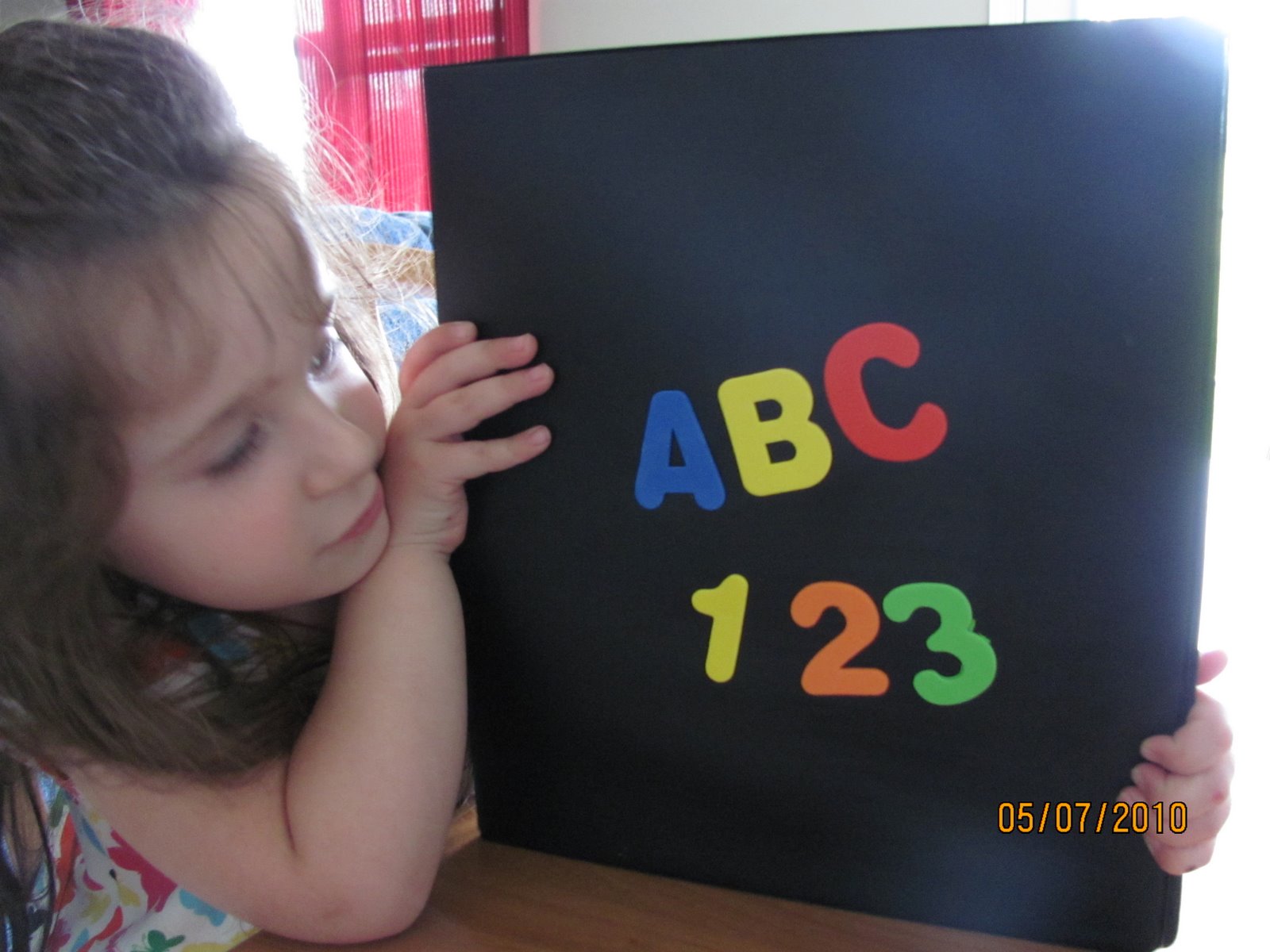
Big Skills for Little Hands: I Can Trace is a great choice for letter tracing for us.  We put each page into a page protector and then made our own book.  M loved putting the foam stickers on it for a title, and it helps her to know how to ask for it by name.  (See her pride?)  (I love that I am trying to purposely NOT be stingy with our foam stickers!  So unlike me!  Let me know how you use foam letters, too!)

We use dry erase markers on the pages.  I have found that as long as the pages are wiped off before putting the book away, it wipes off easily.  If the marker stays on the page for longer, it's hard to clean.


Another thing I like about this book is that it has a picture for the child to trace for each letter and a predictable sentence to read.  Numbers are also included in the book.  Though I love this for my child at her developmental readiness, there is no opportunity for writing the letters/numbers, just tracing them, so it may not be for older children with good writing skills.

I know this is not a unique idea, and I even shared it before for dot-to-dot pages, but I wanted to share it again now that we were using a book.  She just loves it!  M will trace about half the alphabet pages in a sitting, which pleases me.  I let her set her own pace and tell me when she wants to write and when she is done.  At this age, I think that is important.  I don't care how often we work in the book.  I allow her to set the pace.

When appropriate I try to encourage relevant real-world writing, too.  This past weekend when company came, she traced, "Welcome Grandma and Grandpa."  Father's Day is coming up and she will trace a message for four grandfathers, too, I suspect.

Tuesday, January 26, 2010

Photobucket
ABC and 123 is a great resource for anyone looking for play, craft, and school ideas for preschool and school-aged children. Live, Learn, Love was featured today!

Monday, September 7, 2009

File Folder Games

From my days in the elementary classroom, I have appreciated file folder games! Older children can usually use them independently, and younger ones can practice a skill in a fun way. Want a free download? Read on! Integrias Academy is where Shanna, mom of seven children 8 and younger, shares her wonderful artwork and file folders for a very small cost. (They just had their seventh baby at the end of August. Baby L was recently hospitalized, and they could use some prayer support. You can read more about the family at their blog.)
I had the opportunity to review three file folder games. Though she also offers file folders for grades kindergarten to third grade and up, I choose some of her preschool games. (There are more available for the preschool level).
M's favorite is, by far, Seasons Change. She gets to dress Fox in proper clothing depending on the weather/season.
We actually haven't tried this Letter Match game where you match the lowercase envelopes to the proper uppercase mailbox. I think she'll be ready for it fairly soon though.
Busy Buzzing Numbers has the child counting the flowers and matching the proper bee to it. I cut the flowers apart and arranged them out of order. Since this is a number game, M is not interested, yet. (I have hope!)
All of these games are very cute! The drawings are great and reinforce the skills we are working on, or will be soon. It's easy to prepare the game since Shanna has completed the hard work! I just cut, laminated, and glued. (You could use card stock, but laminating will make it extra durable.)
The file folder games for older children have great variety in themes and artwork. I do hope to see more variety for the preschool age in the future. I think boys might like to see more trucks, bugs, and creatures. Everyone loves ice cream though and it's a great way to practice colors!
Interested?? These are quite affordable at $3 each. It's the same cost if she custom designs a folder game for you! Another great option, especially if you plan to homeschool for several years, is her CD. You get all 17 games, for a variety of ages, for just $15! If you'd like to see the quality for yourself before buying, just sign up to be on her email list! You get one free download with sign up! (I think I have only gotten one email in a couple of months time.)
Do you use file folder games? How do you store them? Do you design them yourself or seek help, like from Shanna? I'd love to hear about what you do!

Wednesday, August 19, 2009

Featured On...

Just wanted to share with you that ABC and 123 featured our Moon Magic Painting that we did last week. They're a great resource for me...and will be for many years to come! It's not just for preschoolers! Check out today's post for more space ideas!

Monday, August 3, 2009

Planning Time

In February when M was diagnosed with apraxia, we thought about preschool. Preschools are a language-rich environment and can be very beneficial. We don't know if she will qualify for the developmental preschool with the speech and language classroom, but we did decide not to put her in a regular preschool this fall. Hopefully we'll know later this month or early in September if she is going to the developmental preschool. In the meantime, we'll do a bit of preschool at home. As a mom I have the opportunity to be such a huge influence in my children's lives. I want to take it. M loves to learn. So hopefully this month I will get everything ready and prepared for our own mini-homeschool. I don't consider myself to be a homeschooler. I'm just a mom, wanting to teach my children. However, I am the type of person who needs to plan. (But don't ask me how my meal planning went for July...) So that's why I am going to use some resources for curriculum...but it will be very loosely, not strictly. M will not be in kindergarten for three more years. There is absolutely no need to push her now. Therapy pushes her a lot. I want our school to be fun, but structured for me, so I know what to do and have a plan to implement it. I also think she will enjoy the structure. At this point, I'm looking at a few sites for ideas. Some are Christian sources, with plenty of "other" academics included, too.
  • Hubbard's Cupboard - Detailed lesson plans. It has a curriculum for many different ages. It seems simple, and it has lots of pictures. A Christian curriculum.
  • ABC Jesus Loves Me- This may be a bit advanced for M, since it starts at age 3, but it's still an excellent resource.
  • Preschool Express by Jean Warren. Jean Warren also has lots of books at our tiny local library for preschools. Great learning resources, but not a curriculum. You can find great unit ideas though.
  • Bible Story Sundays- This is new and awesome. I want to do some major themes from the Bible, and I already see this as a great resource for ideas. I will also be able to share what we do, if I want to.
  • Various other blogs/sites that I frequently visit like ABC and 123 and The Home Teacher's Wiki site for ABC ideas. Many of the blogs I visit incorporate lots of meaningful actitivities into their lives each day, but these two sites I am including bc they have their activites so organized.

Of course my local library (especially when I can use two county (on-line) libraries, plus our church library!) is a great resource. I will continue to use it for children's books as well as preschool teaching resources. I really appreciate having two libraries (in two states) within 15 minutes of my home. Where I grew up there wasn't (and still isn't!) a local library within the school district.

I have signed us up for Community Bible Study (CBS). It's a national interdenominational organization that does a great job teaching adults and children. The children's program is awesome, too. I was part of it for two years before. I'll be starting at a new location this time though. If M doesn't go to preschool, this will be a good, structured learning environment for her to supplement Sunday school and Toddler Church.

I'm just starting to think about what to do, but it's hard since I only want to plan a bit since we may not need it for too long. Some things I hope we do before mid-October are apples, moon, family/me, Creation, and Noah's ark. We'll see what happens in reality.

Any tips for organizing my thoughts? Any recommendations for anything? I just hope I don't get overwhelmed!

This Simple Home (The New Blog)

Follow This Simple Home

Best Blogger Tips

sitemeter 2.16.10